In the News: Not Guilty of Harassing Phone Calls
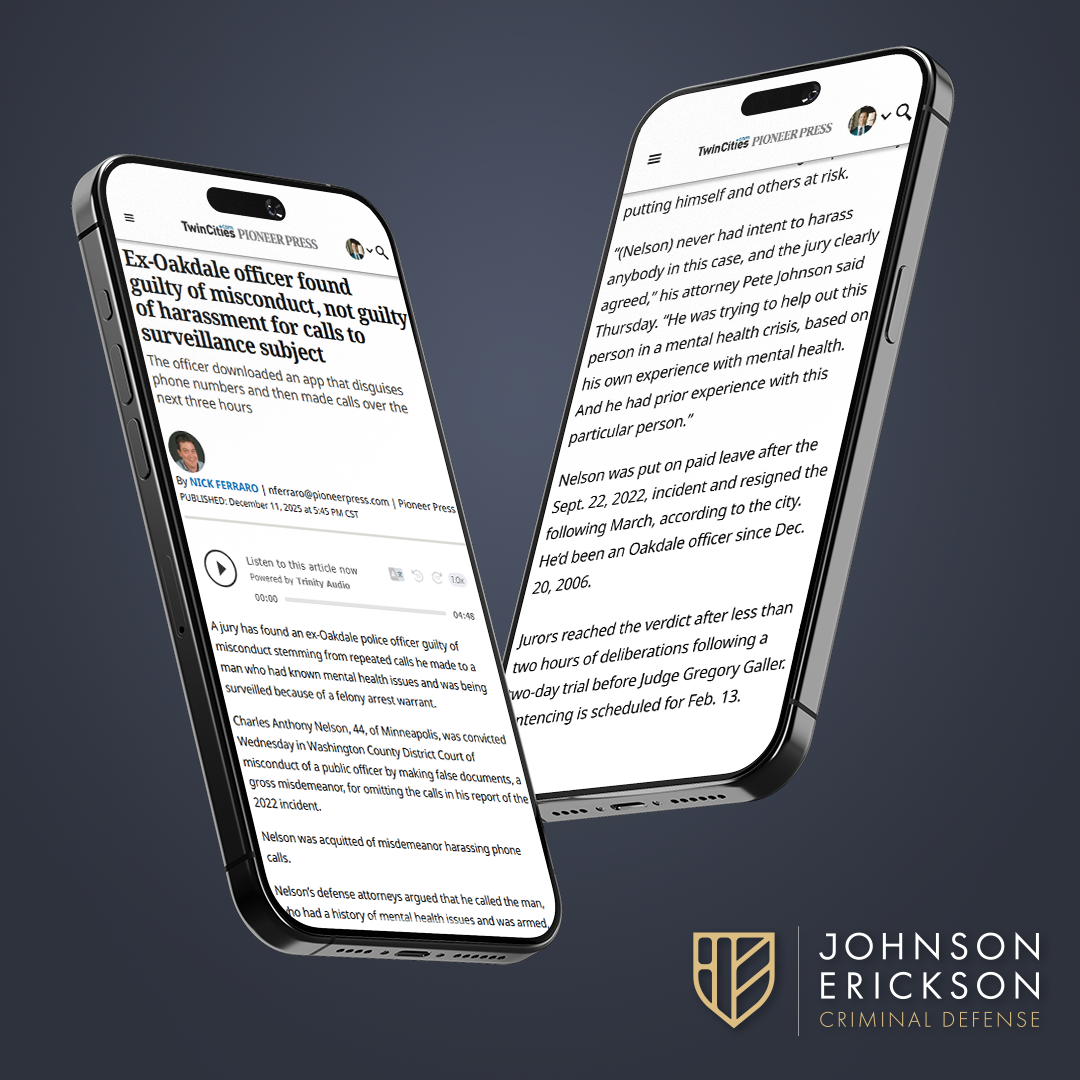
A Washington County jury’s recent verdict in the case against former Oakdale police officer Charles Anthony Nelson delivered a decisive result on the core accusation driving the prosecution: the claim that Nelson intentionally harassed a vulnerable individual through repeated phone calls. After a two-day trial and less than two hours of deliberation, jurors found Nelson not guilty of misdemeanor Harassing Phone Calls, rejecting the State’s theory that his conduct was motivated by malice or an intent to intimidate.
That acquittal was significant. The harassing phone calls charge formed the factual and moral backbone of the State’s case. Prosecutors alleged that Nelson made dozens of calls over several hours with the intent to disturb or harass a man known to have serious mental health issues. The jury’s verdict squarely repudiated that narrative. In doing so, it exonerated Nelson of any finding that he acted with intentional wrongdoing toward the individual at the center of the incident.
As defense attorney Pete Johnson explained after the verdict, the jury’s decision reflected the evidence presented at trial and the absence of any harassing intent. “(Nelson) never had intent to harass anybody in this case, and the jury clearly agreed,” Johnson said. Instead, the defense argued that Nelson’s actions were well-intentioned, rooted in an effort to manage a dangerous situation involving a person in mental health crisis and to take the person safely into custody - which was the express purpose of the operation. “He was trying to help out this person in a mental health crisis, based on his own experience with mental health. And he had prior experience with this particular person,” Johnson added.
The trial outcome followed earlier successes for the defense. Prior to trial, defense counsel Pete Johnson and Bob Paule secured the dismissal of three counts for lack of probable cause, substantially narrowing the case before it ever reached a jury. Those dismissals underscored weaknesses in the prosecution’s charging decisions and reinforced the defense position that the State had overreached in criminalizing Nelson’s conduct.
The remaining charge on which Nelson was convicted—misconduct of a public officer by making false documents—was not based on the phone calls themselves, but on a reporting issue that arose afterward. The jury found that Nelson omitted the calls from his written incident report, a discrepancy the State characterized as intentional falsification. The defense, however, consistently framed this count as collateral to the central allegation of harassment and untethered from any intent to deceive.
Johnson emphasized that omission of information in police reports is often handled informally within departments and does not automatically equate to criminal misconduct. He explained that Nelson believed others in the department were already aware of the calls and that, had supervisors wanted the information included, he would have been asked to amend the report. “He thought, like the normal procedure is, if somebody wanted that to be in there, and thought that was important to this, somebody would talk to him and say, ‘Why don’t you add that to your report before we finalize this?’ That happens routinely,” Johnson said.
That understanding was supported by testimony at trial. According to Johnson, Nelson’s partner testified that “he believed everybody knew who made the calls. … So their understanding was that the supervisors knew and this was no secret, there was no scandal.”
While the conviction on the reporting issue carries consequences that will be addressed at sentencing, it does not alter the jury’s clear rejection of the State’s most serious allegation. The acquittal on Harassing Phone Calls stands as a definitive finding that Nelson did not act with the intent to harass, menace, or emotionally harm the individual involved. For Nelson, that verdict represents vindication on the charge that mattered most—and a jury determination that his actions, however imperfect, were not criminally motivated.